
SURGICAL
Surgical removal of impacted or semi-impacted wisdom teeth
An impacted wisdom tooth is a condition where the wisdom tooth has not risen at all and still exists wholly in the bone.
A semi-impacted wisdom tooth is a condition where the wisdom tooth does not have enough space to fully rise. The semi-impacted wisdom tooth causes inflammation in the surrounding tissues (pericoronitis), caries of the neighboring tooth and continuous injury to the cheek.
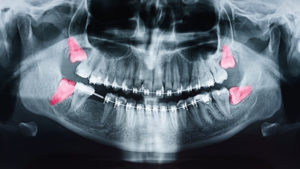
In both cases damage is caused and due to the pressure they exert, it is recommended to remove them through surgery under local anesthesia.
Apicoectomy
Apicoectomy is a surgical operation aimed at removing the root-tip of the tooth.
When a tooth dies as a result of caries or trauma, the germs are transferred to the root-tip and from there to the bone of the jawbone locally, from where the granuloma and then the cyst begin.
A granuloma is chronic inflammation caused by dead teeth that have not been healed. It does not grow, but very often it causes inflammation with severe symptoms of pain and edema.
The cysts are cavities inside the jawbone and consist of a membrane inside the cavity containing fluid. Unlike a granuloma, the cysts grow and destroy the jawbone (absorption), not only locally but also in adjacent anatomical molecules.
An endodontic treatment or a root canal treatment of the tooth responsible, is the first treatment. If the damage caused is minor, then an endodontic treatment alone is enough to heal the tooth and to help the bone regenerate.
Where the endodontic treatment does not suffice and thus we have inflammation again, then we proceed for an additional apicoectomy.
Procedure of Apicoectomy
The procedure is performed at the dental clinic under local anesthesia. As mentioned above, it is a surgery that removes the tip of the root and cleanses the area of the damaged bone.
At the end of the procedure, some symptoms such as external swelling and often hematoma may appear.
As a precaution in order to avoid all this, immediate treatment of caries damages and timely endodontic treatment is recommended, especially after teeth fractures and their necrosis.
Surgical apocalypse of impacted teeth for orthodontics
Where a tooth does not appear in the mouth after normal age, a procedure to assist the situation is followed.
After wisdom teeth, the most commonly impacted teeth are the canine teeth. Unlike wisdom teeth, for which the decision to remove is not difficult as they are not as useful, canine teeth, like other teeth, help in proper dental convergence.
Therefore, close to the age when a tooth should normally rise (without excluding older ages), the placement of orthodontic devices is decided, also commonly known as braces, to create the appropriate space that will accommodate the impacted tooth. Subsequently, a surgical apocalypse of the tooth takes place at the clinic under local anesthesia.
Once the tooth has been exposed, a bracer is attached to it and the orthodontist slowly monitors the moving process until it reaches the appropriate position.
The tooth moves very slowly and the time of arrival at its final position depends on several factors.