
IMMOVABLE PROSTHETICS
Loss of teeth is considered a very important factor in humans as it negatively affects the aesthetic appearance of the person and as a consequence his psychology. Problems arising from this condition are the impact on speech, chewing, movement of adjacent teeth in the empty space resulting in relaxation, to move wrongly and to descend into the vacuum of the opposite jawbone.
There is also the issue of bone resorption, which prevents any implant placement.
Bridges
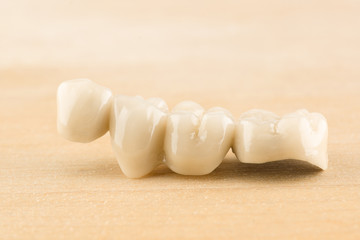
A dental bridge is a permanent prosthetic attachment restoration method that replaces one or more teeth. It rests on adjacent teeth, which are grinded in advance, and it attaches to them in a way by replacing the missing teeth (dental bridge).
Also a bridge can be mounted on implants (implantable bridge).
Crowns
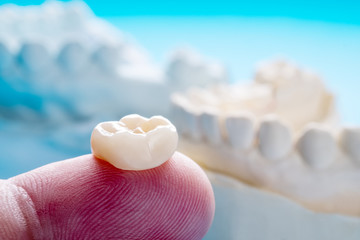
The crown is also a permanently welded prosthetic restoration method, which aims towards the aesthetic and functional restoration of a tooth which lacks much of its dental substance due to caries, trauma or even for its protection after a root canal treatment.
Materials used for the creation of bridges and crowns
Metal-Ceramic
It is the most well-known method of making bridges and crowns. They consist of a metal frame (metal alloy), which is then coated externally with porcelain. They have very good durability and are used in many restoration cases.
Their only disadvantage is their aesthetics, since it often happens for a black line to appear between the teeth and gums due to the metal which may become more intensive in looks over time.
Full Ceramic – Zirconium
They are often the choice of the patient as well as of the dentist when it comes to front teeth. They are completely made and covered with a special type of porcelain with a zirconium frame. There is no metal at all. Their advantage is that as materials they allow the light to penetrate them, bringing out the natural features of the tooth, giving it unique aesthetic results.
Monolithic Zirconium Cad-Cam
It is rightly considered the most technologically advanced material in dentistry today. Not only does it allow the light to penetrate and aesthetically enhance the natural features of the tooth, they are more durable than the ones made out of simple full-ceramic and therefore they may also be successfully applied to the back teeth where a greater extent of forces exists due to chewing.