
The Modern Experience in Dental Implants
The thought of dental implant surgery often causes anxiety: “Will it hurt?”, “How much will I swell?”, “How can the doctor be sure exactly where the implant will be placed?” Modern digital dentistry answers these concerns through surgical guides for guided implant placement (surgical guides).
This is a technological achievement that turns the restoration process into a fully predictable, fast, and painless experience, freeing the patient from the hardship of traditional surgery.


What Is the Implant Surgical Guide?
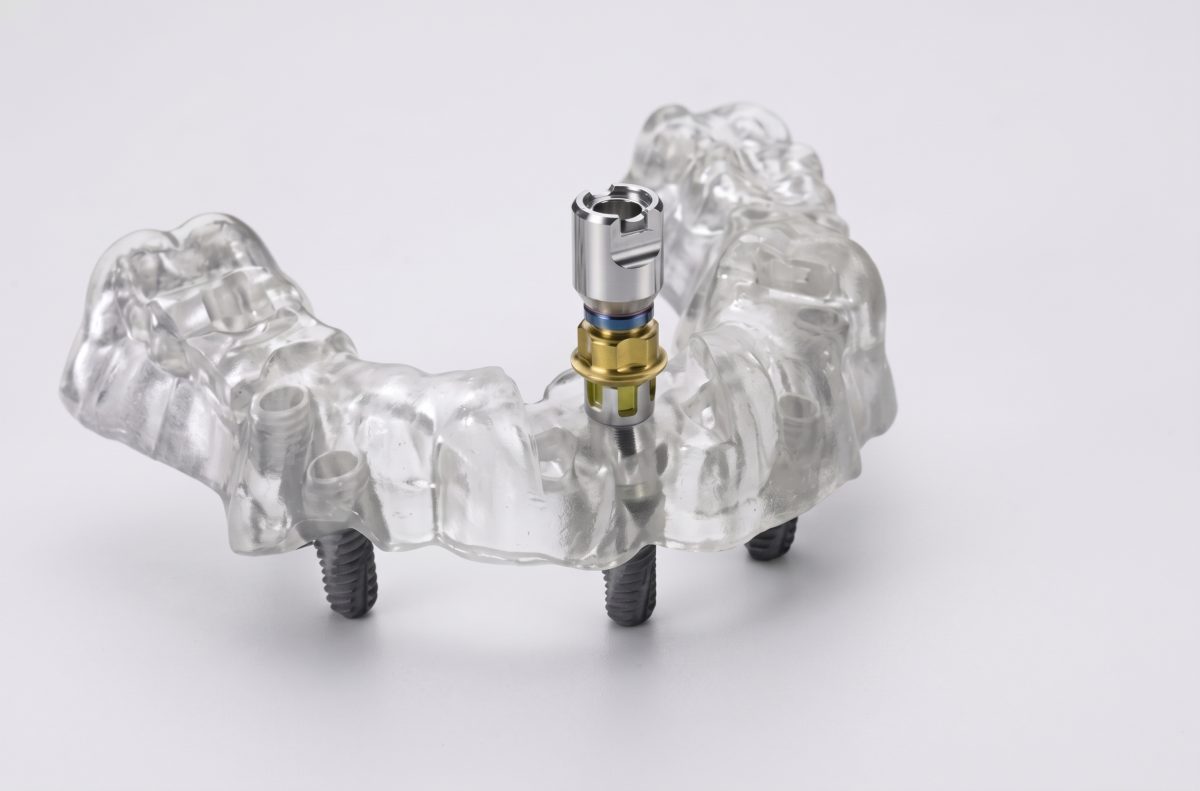
The surgical guide is a special, customized device made of biocompatible medical resin, designed on a computer and 3D-printed exclusively for each patient’s mouth. It fits with absolute precision onto the natural teeth and gums, carrying metal guide cylinders (sleeves) at the sites where the implants will be placed.
Instead of the dentist relying exclusively on a free hand and visual estimation, the guide acts like an unwavering precision GPS. The surgical instruments pass through the rings, allowing the implant to be placed with accuracy of one tenth of a millimeter in position, inclination, and depth.
How It Is Made: The Digital Path Step by Step
The fabrication of the guide is based on the digital merging of the patient’s anatomical data:
- Three-Dimensional Cone Beam Computed Tomography (CBCT): It records in absolute detail the jawbone, its density, and critical anatomical structures, such as nerves and maxillary sinuses.
- Intraoral Digital Scan (Intraoral Scan): It replaces the old paste impressions, creating a digital 3D model of the teeth and gums in real time.
- Virtual Implant Planning: The two files are merged in special software. The doctor first designs the final tooth (the crown) and, based on it, determines the ideal implant position (“prosthetically guided placement”).
- Three-Dimensional Printing (3D Printing): The guide is printed on a medical-grade 3D printer with certified biocompatible resin.
The Main Benefits for the Patient
- Minimally Invasive Experience (Flapless Surgery): In most cases, the gums are not opened with a scalpel. The implant is placed through a tiny hole, without stitches and without bleeding.
- Very Fast and Painless Recovery: Without tissue trauma, postoperative pain and edema (swelling) are eliminated. Patients return to work immediately.
- Maximum Anatomical Safety: The guide has special mechanical stops. It is practically impossible for the instrument to go deeper than planned, eliminating the risk of nerve injury or sinus perforation.
- Flawless Aesthetic & Functional Result: The implant is placed precisely so that it perfectly supports the future tooth, giving a natural smile and excellent chewing function.
- Possibility of Immediate Loading (“Tooth the Same Day”): Because the position is pre-planned, the temporary tooth can be prepared in advance and placed immediately after the procedure.
Is Choosing a Surgical Guide Worth It?
Guided implant placement does not replace the doctor’s clinical experience — but it offers them the ultimate digital tools to achieve maximum safety, aesthetics, and longevity.
If you are planning to proceed with implant restoration, ask your dentist whether your case can be performed using a digital surgical guide. It is the investment that turns your treatment into a comfortable, calm, and fully predictable experience.