
AESTHETICS
Veneers
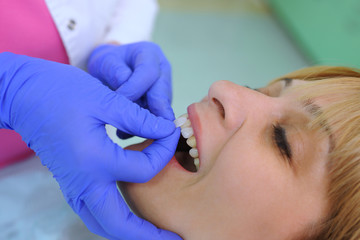
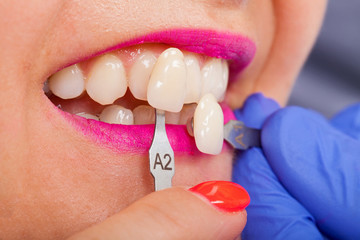
The veneers are very thin, made of a special peel-like ceramic material that is permanently welded, mainly to the front teeth as facades. They are usually applied in cases where the teeth are sparse and we want to close any gaps. They are also applied to teeth with many seals, discolored teeth and in general where the ultimate aesthetic effect is the patient’s primary objective. The color of the veneers never changes regardless of the eating habits of the patient.
Most teeth that will be receiving the veneers treatment usually require a prior small preparation.
The veneers are not applicable to patients with bruxism (teeth rubbing), gingivitis and periodontitis issues and in general on crooked teeth.
They are manufactured in a laboratory in collaboration with the dental technician.
Bonding
A bonding is created entirely by the dentist and the procedure is completed within one appointment. It is a more conservative front teeth restoration solution. It is also a more cost-effective solution since there is no need for the involvement of a dental technician.
It is not necessary for the teeth to be grinded. The effect of the bonding is not permanent since the composite resins are less durable and they may also have a change in color depending on the patient’s eating habits or from smoking.
Their advantage is that they can be easily modified or replaced at any time.
Whitening
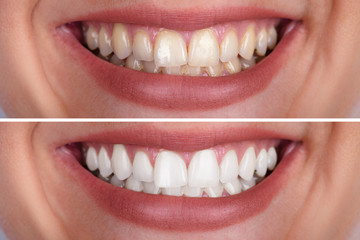
Teeth whitening is the procedure by which the teeth regain their white color. Before the commencement of the whitening procedure, the teeth must receive a cleaning treatment in order to remove potential dental plaque and dental tartar, any stains from the pigments, but also to identify any possible problem of tooth decay that might pre-exist.
There are two methods of teeth whitening:
First Method
It is performed at the dental clinic through a special whitening lamp (blue light). It is performed solely by a dentist since the gums need to be isolated to avoid any contact of the gums with that the material.
The results are immediately visible. It is a quick process that takes about 1 hour while the patient does not need to do anything.
Second Method
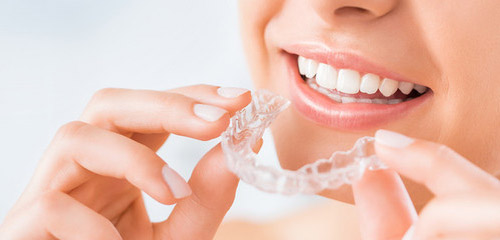
It is performed at home with personalized, custom-made teeth-splints made by the dentist after imprinting on the patient’s mouth.
After the application of the teeth-splints, a whitening material, of lower concertation than the one used at the dental clinic, is given to the patient in order to be used at home.
Unlike the teeth-whitening process performed at the dental clinic, the one performed at home requires more time, roughly 2-3 weeks for the effect to become visible and at during the period of the process, the consumption of pigmented beverages and foods as well as smoking should be avoided.
It is important to know that the combination of both these methods, first the whitening at the dental clinic and then the continuation at home with the teeth-splints for a few days, can help to achieve even better results while making the end-results last longer.
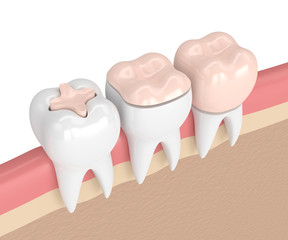
Inlay – Onlay – Overlay
These are structures for the restoration of mainly the posterior teeth.
They are made of porcelain or composite resin in the dental laboratory. They are called inlay, onlay and overlay depending on the part and size of the tooth which are placed.
They are used just like common fillings to make up for the part of a tooth that is damaged due to caries or fractures.
After proper preparation, with a mouth imprint performed by the dentist, they are manufactured in the laboratory and then they are permanently glued to the tooth.
It is a very good solution in cases where the extent of the injury does not allow for safe repair only by filling but at the same time it is not so extensive as to require full coverage of the tooth with a crown.
It is consider a better solution from a filling due to higher aesthetics, greater durability while it also protects the tooth from breaking.
However, the disadvantage of this solution is its cost compared to a filling.